

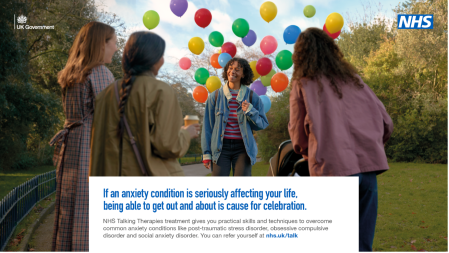
NHS South Yorkshire would like to encourage people in South Yorkshire to access talking therapies if they feel like it could help.
Talking therapies aren’t just for people with the most serious mental health conditions, they could also benefit:
- People with anxiety disorders
- People with OCD
- People with physical health conditions that is affecting their mental wellbeing
- People with depression
- People with panic disorder
- People with PTSD
- People with Body dysmorphic disorders
- People suffering from phobias
NHS Talking Therapies provide people with the practical skills and techniques they need to carry on with life, and overcome their struggles.
Dr Adrian James, NHS England’s National Medical Director for Mental Health and Neurodiversity said: “While it’s encouraging that thousands more people facing mental health conditions are accessing NHS support than before the pandemic, we know that millions more could benefit from vital NHS talking therapies.
“Through proven treatment and support available for free on the NHS, these conditions can be overcome to help people return to work, regain confidence or feel back to their old selves in social situations.
“Our message is clear, if you’re struggling with your mental health, NHS talking therapies are here for you, and you can either self-refer or speak with your local GP practice”.
Anyone can self-refer online without needing to see their GP or have an already diagnosed mental health condition.
The campaign puts a spotlight on 6 common mental health conditions that are often overlooked or underplayed but can be treated with NHS Talking Therapies.
Common symptoms for these conditions include:
- frequent obsessive thoughts and compulsive behaviours (OCD)
- long-term and overwhelming fear of social situations (social anxiety disorder)
- involuntarily and vividly reliving traumatic events in the form of flashbacks or nightmares (PTSD)
- having regular and sudden panic attacks, often for no apparent reason (panic disorder)
- having an overwhelming and debilitating fear of an object, place, situation, feeling or animal (phobia)
- obsessive thoughts and worry about your appearance (body dysmorphic disorder)
However, talking therapies are not only for people with mental health conditions, they can also help if you are struggling with your physical health too.
You can find out more by clicking here.