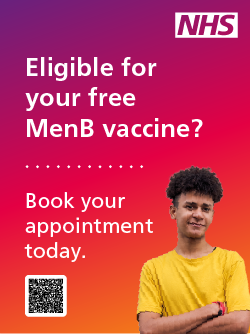
Protect yourself against meningitis B
Some young adults can get free NHS MenB vaccinations this year.
They are recommended to help protect those at highest risk from MenB disease.
MenB disease is a serious bacterial infection which can cause meningitis, blood poisoning, and sepsis. It progresses very quickly and can be fatal.
Students in their first year of university have a risk that is about 7 times higher than that of young people of a similar age who do not go to university.
Health leaders are warning that MenB can spread through close contact, particularly in shared accommodation, and while rare, can develop rapidly, causing life-changing complications and in some cases death.
Who is eligble?
-
people born between 1 September 2007 and 31 August 2008
-
people born on or after 21 July 2001 and starting university for the first time this autumn
- people born on or after 21 July 2001 who are starting in some residential further education colleges for the first time this autumn
How do I get my vaccine?
17 and 18-year-olds can book via the NHS National Booking Service for appointments at community pharmacies. Other eligible young people can contact a participating pharmacy to book an appointment.
Anyone who misses getting vaccinated before starting university can still get a first dose before 31 December, with second doses available until 31 March 2027 at participating pharmacies.
The MenB catch-up campaign is the NHS’s largest ever, running across England to protect a cohort of young people identified as being at significantly higher risk due to university and residential college attendance.
Two doses of the MenB vaccine are necessary, at least 28 days apart.
- Book your 1st dose online at www.nhs.uk/book-menb, or
- Find a walk-in site at www.nhs.uk/menb-walk-in
You will be able to book your 2nd dose once you have had your 1st dose.
What is MenB?
Meningococcal B is a serious infection that can affect anyone. The infection can develop quickly and it can cause serious, life-threatening problems including inflammation of the lining of the brain and sepsis (blood poisoning).
This can lead to life-changing disabilities such as amputations, hearing loss and brain damage – and in some cases can prove fatal.
The bacteria that cause MenB disease can be spread through close contact with an infected person. This can be through kissing, sharing drinks or vapes, or prolonged close contact with the person for long periods of time, such as living in the same home.