

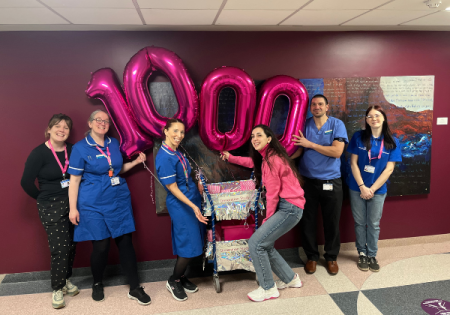
More than 1,000 expectant parents have signed up to a revolutionary genetic study at Jessop Wing which is helping to detect rare genetic illnesses in new-born babies.
The Generation study is being led nationally by Genomics England in partnership with NHS England and aims to screen 100,000 newborn babies in England using a technology called whole genome sequencing for more than 200 rare genetic conditions. If detected early, these conditions, can be treated.
Most babies will not be found to have any of the gene changes known to cause the genetic conditions tested for. However, for the small number of babies who are found to have a rare genetic condition the impact could be life changing.
The long-term study is referenced in the NHS Ten Year Health Plan, and forms part of the Government’s plans to aid earlier detection and identify the potential for universal screening for rare disease at birth. It is open to all expectant parents and families giving birth at Jessop Wing.
The study involves the collection of a newborn blood sample, usually taken from the umbilical cord. This sample is then sent for DNA extraction and analysed for genetic changes linked to over 200 rare diseases. All parents and families signing up to the study will have their decision confirmed by a member of the Jessop Wing research team before the sample is taken.
Sam Coombes, 39, from Walkley, whose baby is due in March, is the 1,000th participant to sign up to the Generation Study at Jessop Wing.
She said:
“I decided to take part as I am keen to support any research that can help us to understand more about rare conditions. Often, the earlier you can detect conditions, the better the prognosis, so knowing this could potentially help my baby and others is reassuring.”
Sam, who chose to have her baby solo with IVF and donor sperm, is also mum to two-year-old Luca from the same donor.
“Any testing could potentially help him as well, as you only get basic information about the donor,” she added.
Natalie Khoaz, Jessop Wing Research Midwife and Principal Investigator for the Generation Study in Sheffield, said:
“We are thrilled to meet the 1,000th patient milestone in the Generation Study at the Jessop Wing. Most babies will not be found to have a rare condition, but we are extremely proud to be supporting this pioneering national study which has already identified numerous rare conditions earlier in newborns. One such case was a rare eye cancer being detected in a baby at just four weeks old, which wasn’t picked up through standard eye tests following birth, after his parents signed him up to the study at Jessop Wing. This has enabled him to access vital treatment that gives doctors the best chance to minimise the impact on his vision.
“We would also like to thank all our amazing midwives and the dedicated research team for their tremendous efforts in delivering this life-changing research, supporting families throughout the process, and ensuring the successful participation of so many expectant parents in the Generation Study.”
Expectant parents can register their interest in the study by visiting the Generation Study website and selecting Sheffield. The Jessop Wing Generation Study Team can also be contacted for more information on 0114 226 8333 or via sth.generationstudy@nhs.net.